
“Yezhu swarangalukkul etthanai paadal?!”. Translation: “How many songs built with just 7 swaras?! This song is one of the legendary creations of the South Indian Music Maestro MSV.
Just like shruthi being the scale, the swaras are alphabets. English has 26 alphabets. Tamil has 216 alphabets. Carnatic Music has 7 alphabets. Can you believe it? Just 7 and it rules the world.
Note: Swaras are referred to as ‘notes’ in Western Music.
Swaras form the parts of the tunes/raagas, just like the alphabets get together to give us a meaningful word. The basic 7 swaras are Sa, Ri, Ga, Ma, Pa, Dha, Ni.
When the swaras make a raagam, it will take an ascending and a descending form. Why? A tune/raagam has to traverse up and down. The swaras that form the ascending tunes are called Aarohanam referred by the symbol “/”. And the swaras that form the descending tunes are called Avarohanam referred by the symbol “\”.
That sounded just like an answer to a 2 mark question in an exam right? 😉 Now let us put a table and earn some extra marks.
| Ascending Swaras | Sa, Ri, Ga, Ma, Pa, Dha, Ni |
| Descending Swaras | Sa, Ni, Dha, Pa, Ma, Ga, Ri |
Nomenclature:
The swaras Sa,Ri,Ga,Ma,Pa,Dha,Ni are actually the short forms of its names.
| Swaras | Nomenclature |
| Sa | Sadjam |
| Ri | Rishabham |
| Ga | Gaandhaaram |
| Ma | Madhyamam |
| Pa | Panchamam |
| Dha | Dhaivatham |
| Ni | Nishaadham |
Swarasthaanam:
Swara = Notes; Sthaanam = Position
They say that the music Goddess Saraswathi and her son Naaradhar invented millions of raagas. But, with just 7 swaras, how can one create millions of raagas? That’s the twist!
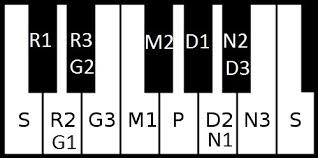
Each of the 7 swaras takes its own position. There are 12 swarasthaanams. But there are only 7 swaras. So, what happens? Some swaras take more than 1 position. This position varies from raaga to raaga. Hence, these swaras that take a different position, will have its own types. The types of each swara has cool names! Let me show you.
| Swaras | Types |
| Ri | 1. Suddha Rishabham(Ri 1) 2. Chathursruthi Rishabham (Ri 2) 3. Shatsruthu Rishabham (Ri 3) |
| Ga | 1. Suddha Gaandhaaram (Ga 1) 2. Saadharana Gaandhaaram(Ga 2) 3. Anthara Gaandhaaram (Ga 3) |
| Ma | 1. Suddha Madhyamam (Ma 1) 2. Prathi Madhyamam (Ma 2) |
| Dha | 1. Suddha Dhaivatham(Dha 1) 2. Chathursruthi Dhaivatham (Dha 2) 3. Shatsruthi Dhaivatham (Dha 3) |
| Ni | 1. Suddha Nishaadham (Ni 1) 2. Kaisiki Nishaadham (Ni 2) 3. Kaakali Nishaadham (Ni 3) |
Yeah, I was kidding. They are really difficult to remember unless and until you keep hearing these terms. Where to and how to keep hearing them? You got to follow my series of upcoming blogs where I’ll often be referring to these. That’s how 😉
If you notice, you’ll see that ‘Sa’ and ‘Pa’ are missing in the table. That’s because these are like anchor rods for any raagam and has no types. In short, both of these swaras are constants.
Interesting fact: At times, few swaras take the position of another swara to give a very uniquely beautiful feel. The below will show you the positions of the swaras.

The iron thrones for swaras:
- Notating a song/tune:
We are in the 21st century. Yet, we still sing songs that our ancesters wrote around 1000 years ago. Ever wondered how that would be possible?
The most obvious answer is, through the composer’s descendants. It came along all the way and is reaching us now. However, there are millions of songs out there. How did most of it reach us? If a composer had composed a 1000 songs, his disciple might have learnt roughly 500 odd songs. When the knowledge trickles down, many are lost in the process. The only one that saved us all from losing so many millions of compositions are scripts.
This is where the swaras/notations take the throne. The scripts will not only have lyrics but also the swaras that guides us with the tune. This way, by following the swaras, one can easily learn the song by synchronising the lyrics with the swaras. For this, you should have a strong knowledge of swaras, its positions and the symbols that indicates the pause, extensions etc. I’ll walk you through these in the later stages.
This is how a notated lyrics will look like:
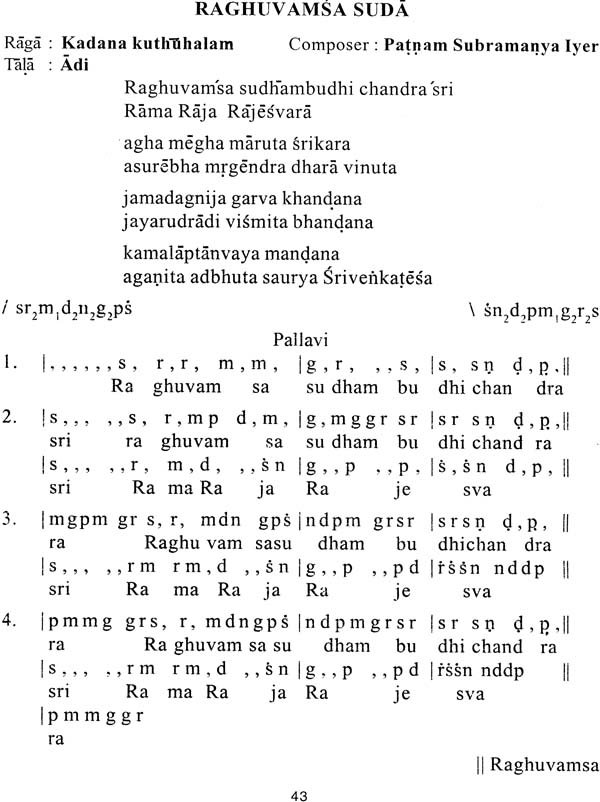
The aarohanam and avarohanam will give you which type of swaras make up the raaga Kadana Kuthukalam. When the song is notated, it is done in such a way that every swara is placed on top of the syllables of the lyrics. This way, you can match the syllables to swaras and slowly start framing the song.
In the above example, the same line is repeated 4 times with variations in notations. This is to show the variations in the tune. These are called “Sangathi” which in short, are embellishments that adorns the line. Remember? Carnatic music is all about innovations.
Well, I sang the above notation with the song to show you how its done! But guess what happened. I’m in the free version of wordpress which wouldn’t allow me to upload an audio file 😛 Sorry about that!
In some songs, the swaras will appear as chitta swaram, which are set of swaras, that comes in the middle of the song to make it more interesting to listen. The Raghuvamsa Sudha that is mentioned above, also owns a very interesting chitta swaram.

2. An ornament of Manodharmam:
Before I explain this second throne, let me tell you what Manodharmam is. Anything apart from the pieces that are scripted is Manodharmam.
Manodharmam = Innovation done on the spot within a raaga’s framework.
In today’s era, Manodharmam has 3 main ornaments:
- Alapana – Sung before a song to elaborate the raaga’s beauty in and out.
- Neraval – When the song is sung, one specific line is taken(generally from the Charanam portion, which is the 3rd part of a song) and is innovated within the raaga and a thaala frame.
- Swaram – This is the 2nd throne of the swaras. For the chosen line, after singing the neraval, the artists start ornamenting the line with swaras of that raaga within the thaala frame.
Manodharmam in itself is a vast space which I’ll come to, at a later point in time.
This beautiful piece of the artists Ranjani & Gayatri in Raaga Bhairavi, will give you an idea as to what Manodharmam is, and where the swaras take its role. Listen to it and you’ll thank me – Upachaaramu.
When I drink a cup of coffee, I prefer not to eat or drink anything after that for sometime. Because, I love the taste lingering for sometime and let it intoxicate me. I know you would have enjoyed Ranjani-Gayatri’s video. Let that stay in your thoughts and I’m leaving you there…
 Carnatic Jam