The Art Of Performance

Disclaimer: I know you will land on this blog expecting to learn something new and basic about Carnatic Music. But, today, I’m going to change course and pull you into an interesting topic.

Performance:

Performance, in itself is an art I would say. Performing what we know, or was taught, is not a big deal. How do we connect with the audience? That matters a lot. As long as you understand your audience, your performance will stand out.

Bharat Sundar, one of today’s prominent artists in the field of Carnatic Music, made me write this (not literally, rather inspired me to write). After listening to a one and half hour Pallavi concert in Mylapore Fine Arts a couple of days back, his music just urged me to give him an entire blog post. I’m taking his concert as an example to cruise you through the art of performance.

Todi’s Thaandav:

The pallavi “Thiruparam Thiruchandhur Pazhanimalai Muruga, Thiruveragam Thiruthanigai Pazhamudhircholai “ was set to the Raaga Todi. /S R1 G2 M1 P D1 N2 S \S N2 D1 P M1 G2 R1 S.

One might think, what’s much to sing in Todi? You have the set of notes, traverse front and back and you’re done. Nope! That’s not it. When the artist slides from S to R1, one can find how good the artist has understood Todi. Bharat is one such who quickly showed the essence of Todi and started building on top of it.

Elements of surprise:

When we’re watching a movie, what makes us feel a knot in our throat and glue us to the edge of our seats? Elements of surprise. In a horror movie, we don’t gasp when the ghost shows up in the start of the movie itself. If this happens, we’ll get used to the face of it right at the beginning, which dissolves the purpose of sitting throughout that horror movie. You lose the horror in that.

On the contrary, if the director builds the story strongly, wait for the moment, introduce a stunning silence and then jerk us all with the appearance of the ghost, target hit.

Well aware, Bharat drew the audience attention to him with the right build up. Him introducing the elements of surprise at the right moments gave us gitters. That made us all sit.

Handling the sangathis and sprinkling them in between the melodic segments at the right time was handled exceptionally by him. Oh! The best elements were Graha Bedham(A huge topic of discussion, but, in short, showing glimpses of another Raaga, in the raaga that’s being performed. In this case, Todi is the parent raaga). He effortlessly went on to glide down the raagas like Kalyani and Karaharapriya. Not too much not too less. Some of his experiments in the Pallavi made us even smile out of joy.

Beauty in disguise:

Let’s take a comedy show. The build up is done, the joke is cracked but the audience still did not connect. Where could the equation have gone wrong?

Modulation. It is the beauty in disguise. The build up of the story and the flow is not set right, if there is no modulation. If you don’t incorporate it, then its a failed communication of the actual emotions.

With his spectacular display of dynamics and modulation, Bharat held us all spell-bound. I was at the edge of my seat, eyes wide, ears full open, to not miss even a single beautification of the Todi he does. It received him so much applause from the crowd.

There needs to be some balance between the brighas and the dynamics. Too much of Brighas in a performance will compromise the beauty of a raaga. One can sure learn from Bharat’s concert as to how to strike this balance throughout the performance.

A strict thala tightness:

Pakka vaadhyams should be pakkaa vaadhyams in any concert. Especially, when a pallavi with such difficult patterns of thala is rendered, it is all the more important for the co-artists to be on the same page.

Let me tell you what kind of alertness is required for the entire team to perform this. When a group of singers attempt an entirely harmonized song, if one misses their part and touches a wrong note, the other set of people tumble and collapse.

Mapping it to Pallavi, every artist on stage should be alert on not missing the thala metre, while cruising through the pallavi. L. Ramakrishnan on the Violin, was just as amazing as Bharat. Oh, infact, some of his responses to Bharat’s phrases were exceptional that it got him unstoppable applause. Sumesh on the other hand, was spinning his magic with his wand- Mridhangam. It was as if he threw himself into the well of the pallavi’s thala that drove him right from within. And to equally respond to him was Chandrasekar Sharma on the Ghatam.

Stage presence:

Closing the eyes and singing on and on is going to make the audience feel left out. The singers interacting with their co-artists is another amazing sight. Bharat nods and Sumesh plays just as expected. Such was their interaction. Why is this important? With no coordination amongst the artists, the overall concert, will sound absolutely disconnected, how much ever good the performers were, individually.

As and when I’m writing this, I feel this urge to show off, to all who’s reading this and could not make it to the concert 😛

Listen and learn:

When you do not know Hindi and want to learn the language, how many ever spoken Hindi classes you go to, you can master it, only when you have a North Indian family in the neighbourhood, watch a lot of Hindi movies or you relocate to North India.

Whatever theory you learn, how many ever classes you go to, nothing like going to a concert and getting your minds enriched with a lot of learnings. Concerts like Bharat Sundar’s are must goes. Watch out for it and block your calendar the next time! 🙂

The alphabets of Carnatic Music

“Yezhu swarangalukkul etthanai paadal?!”. Translation: “How many songs built with just 7 swaras?! This song is one of the legendary creations of the South Indian Music Maestro MSV.

Just like shruthi being the scale, the swaras are alphabets. English has 26 alphabets. Tamil has 216 alphabets. Carnatic Music has 7 alphabets. Can you believe it? Just 7 and it rules the world.

Note: Swaras are referred to as ‘notes’ in Western Music.

Swaras form the parts of the tunes/raagas, just like the alphabets get together to give us a meaningful word. The basic 7 swaras are Sa, Ri, Ga, Ma, Pa, Dha, Ni.

When the swaras make a raagam, it will take an ascending and a descending form. Why? A tune/raagam has to traverse up and down. The swaras that form the ascending tunes are called Aarohanam referred by the symbol “/”. And the swaras that form the descending tunes are called Avarohanam referred by the symbol “\”.

That sounded just like an answer to a 2 mark question in an exam right? 😉 Now let us put a table and earn some extra marks.

Ascending SwarasSa, Ri, Ga, Ma, Pa, Dha, Ni
Descending SwarasSa, Ni, Dha, Pa, Ma, Ga, Ri

Nomenclature:

The swaras Sa,Ri,Ga,Ma,Pa,Dha,Ni are actually the short forms of its names.

SwarasNomenclature
SaSadjam
RiRishabham
GaGaandhaaram
MaMadhyamam
PaPanchamam
DhaDhaivatham
NiNishaadham
Image result for Mind blown GIF
Was your mind blown? 😉

Swarasthaanam:

Swara = Notes; Sthaanam = Position

They say that the music Goddess Saraswathi and her son Naaradhar invented millions of raagas. But, with just 7 swaras, how can one create millions of raagas? That’s the twist!

Each of the 7 swaras takes its own position. There are 12 swarasthaanams. But there are only 7 swaras. So, what happens? Some swaras take more than 1 position. This position varies from raaga to raaga. Hence, these swaras that take a different position, will have its own types. The types of each swara has cool names! Let me show you.

SwarasTypes
Ri1. Suddha Rishabham(Ri 1)
2. Chathursruthi Rishabham (Ri 2)
3. Shatsruthu Rishabham (Ri 3)
Ga1. Suddha Gaandhaaram (Ga 1)
2. Saadharana Gaandhaaram(Ga 2)
3. Anthara Gaandhaaram (Ga 3)
Ma1. Suddha Madhyamam (Ma 1)
2. Prathi Madhyamam (Ma 2)
Dha1. Suddha Dhaivatham(Dha 1)
2. Chathursruthi Dhaivatham (Dha 2)
3. Shatsruthi Dhaivatham (Dha 3)
Ni1. Suddha Nishaadham (Ni 1)
2. Kaisiki Nishaadham (Ni 2)
3. Kaakali Nishaadham (Ni 3)

Yeah, I was kidding. They are really difficult to remember unless and until you keep hearing these terms. Where to and how to keep hearing them? You got to follow my series of upcoming blogs where I’ll often be referring to these. That’s how 😉

If you notice, you’ll see that ‘Sa’ and ‘Pa’ are missing in the table. That’s because these are like anchor rods for any raagam and has no types. In short, both of these swaras are constants.

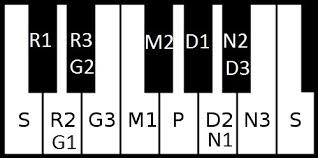
Interesting fact: At times, few swaras take the position of another swara to give a very uniquely beautiful feel. The below will show you the positions of the swaras.

The iron thrones for swaras:

  1. Notating a song/tune:

We are in the 21st century. Yet, we still sing songs that our ancesters wrote around 1000 years ago. Ever wondered how that would be possible?

The most obvious answer is, through the composer’s descendants. It came along all the way and is reaching us now. However, there are millions of songs out there. How did most of it reach us? If a composer had composed a 1000 songs, his disciple might have learnt roughly 500 odd songs. When the knowledge trickles down, many are lost in the process. The only one that saved us all from losing so many millions of compositions are scripts.

This is where the swaras/notations take the throne. The scripts will not only have lyrics but also the swaras that guides us with the tune. This way, by following the swaras, one can easily learn the song by synchronising the lyrics with the swaras. For this, you should have a strong knowledge of swaras, its positions and the symbols that indicates the pause, extensions etc. I’ll walk you through these in the later stages.

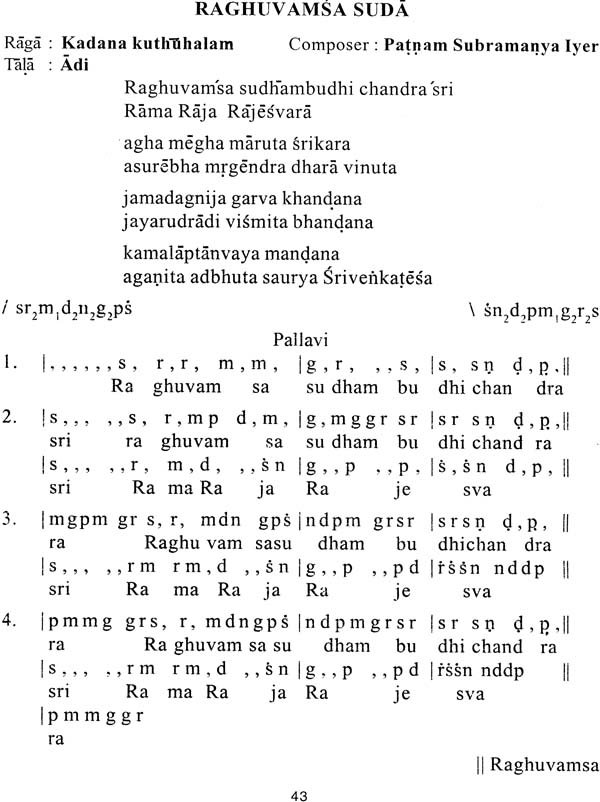
This is how a notated lyrics will look like:

The aarohanam and avarohanam will give you which type of swaras make up the raaga Kadana Kuthukalam. When the song is notated, it is done in such a way that every swara is placed on top of the syllables of the lyrics. This way, you can match the syllables to swaras and slowly start framing the song.

In the above example, the same line is repeated 4 times with variations in notations. This is to show the variations in the tune. These are called “Sangathi” which in short, are embellishments that adorns the line. Remember? Carnatic music is all about innovations.

Well, I sang the above notation with the song to show you how its done! But guess what happened. I’m in the free version of wordpress which wouldn’t allow me to upload an audio file 😛 Sorry about that!

In some songs, the swaras will appear as chitta swaram, which are set of swaras, that comes in the middle of the song to make it more interesting to listen. The Raghuvamsa Sudha that is mentioned above, also owns a very interesting chitta swaram.

2. An ornament of Manodharmam:

Before I explain this second throne, let me tell you what Manodharmam is. Anything apart from the pieces that are scripted is Manodharmam.

Manodharmam = Innovation done on the spot within a raaga’s framework.

In today’s era, Manodharmam has 3 main ornaments:

  1. Alapana – Sung before a song to elaborate the raaga’s beauty in and out.
  2. Neraval – When the song is sung, one specific line is taken(generally from the Charanam portion, which is the 3rd part of a song) and is innovated within the raaga and a thaala frame.
  3. Swaram – This is the 2nd throne of the swaras. For the chosen line, after singing the neraval, the artists start ornamenting the line with swaras of that raaga within the thaala frame.

Manodharmam in itself is a vast space which I’ll come to, at a later point in time.

This beautiful piece of the artists Ranjani & Gayatri in Raaga Bhairavi, will give you an idea as to what Manodharmam is, and where the swaras take its role. Listen to it and you’ll thank me – Upachaaramu.

When I drink a cup of coffee, I prefer not to eat or drink anything after that for sometime. Because, I love the taste lingering for sometime and let it intoxicate me. I know you would have enjoyed Ranjani-Gayatri’s video. Let that stay in your thoughts and I’m leaving you there…

The rule of scale

Before I start, a quick heads up! If you’re a Carnatic music expert, then this wouldn’t quite interest you, since this is for anyone who wants to know the basics of it!

“Do you sing? That’s great! You know? I’ve always wanted to understand the basics of it. When I watch reality shows, they use terms like Shruthi, Thalam, Raagam and I’d all of a sudden feel like I’m watching a Greek show. So, what is all that?” is the often asked question by my friends and music enthusiasts. This is me, when they easily ask me to explain all of it.

We all say that the art of Carnatic music is slowly drowning in deep sea. However, I see that people get drowned since it is an ocean and they get clueless as to where and how to know about it.

This is my attempt to explain the basics of Carnatic Music and take you all through the depths of it.

Just like any language that has Grammar defining and shaping it, Carnatic music too, has Grammar, without which it is a body without life. One such rule is Shruthi. Now don’t get confused, she is not the daughter of Saraswathi.

What is Shruthi?

When I ask you to draw a line without giving you a scale, how would the line look like? And when you start writing on the line you just drew? That would be haphazard. Alright, now let me give you a scale. When you draw a line using it and start writing on the perfectly drawn line, with no doubt, that would be legible, neat and readable. Wouldn’t it? The scale is nothing but Shruthi. In western music, they call Shruthi as ‘scale’. You see what I did there? 😉

In short, Shruthi/scale is a level of frequency that will be constant throughout a performance/song/show.

There are different frequencies from which a person can choose, according to their voice and range. These are the available Shruthi/frequencies:

ShruthiAnother reference
A6
A#6 1/2
B7
B#7 1/2
C1
C#1 1/2
D2
D#2 1/2
E3
F4
F#4 1/2
G5
G#5 1/2

For example: A female voice has higher range and can reach higher frequencies. The scale that is suitable for me is ‘G’. Male voices are strong and has more depth. They have lower frequencies. Hence, male singers choose scales like B, B#, C.

Note: ‘#’ is pronounced as ‘sharp’.

How do you choose a scale for your voice?

This is pretty simple. If you are a female and when you set a Shruthi, say ‘G’, if you are able to sing the lower and the higher octave ‘Sa’ comfortably, then you can shortlist that scale. I know you have a question here. Majority of you, who can do this with the ‘G’ scale, will also be able to do it for the scales ‘F’, ‘F#’, ‘G’, ‘G#’. At times even ‘A’. To shortlist the one suitable scale, I’m going to go a bit in-depth.

There are 3 octaves(we can call it range) which are lower, middle, higher. The general range we sing in, is the middle range. To decide your shruthi, try pushing your limits in the lower and the higher octaves. By which I mean, try singing notes below lower octave “Sa”(sa,ni,dha,pa,ma,ga,ri,sa) and the ones above the higher octave “Sa”(sa,ri,ga,ma,pa,dha,ni,sa). When you do this exercise, the scale in which you’re able to sing the maximum number of lower and higher octave notes, is your shruthi. If you are able to hit all the notes in all the 3 octaves, then either your voice is blessed, or you’ve mastered your voice with immense practice.

Remember. When you try choosing a scale, you should feel comfortable while singing, in that particular scale.

Sources of Shruthi:

Irrespective of what the source is, the thumb rule for Shruthi is, it will always have 2 notes as reference notes. Those are ‘Pa’ and ‘Sa’. Why these notes? Because they serve as anchors for any scale and are constants for any tune/Raagam.

(i) Tambura: In Carnatic music world, people use Tambura, a simple string instrument, that has to be plucked constantly, to produce Shruthi comprising the notes ‘Pa’ and ‘Sa’. Tambura has 4 strings each when plucked, rings the following notes – ‘Pa’,upper ‘Sa’,upper ‘Sa’, lower ‘Sa’. People often confuse Tambura with Veena(another string instrument). Here’s how both the instruments look like.

Tambura
Veena

Now you can show off to your friends if they name it wrong 😉

(ii) Shruthi box: This is a modern day electronic device that is extensively used by singers in their concerts. While Tambura produces the very authentic sound of Shruthi and sets the ambience for the concert, a Shruthi box takes off the manual intervention and makes it easier for the singers to just focus on their singing. Shruthi box is an amazing invention that is manufactured to constantly produce Shruthi that is close enough to that which is produced by Tambura. Radel is the most trending company that is known for shruthi box and the different varieties in it.

The ambience:

It’s such a beauty that, once you start playing the Tambura or switch on your Shruthi box, just listening to the Shruthi for a few minutes will set the ambience and mood to sing or listen to some music.

Hear it for yourself. This is how a ‘G’ Shruthi sounds like!

Synonymes of Shruthi: Scale, range, pitch.

Now when I think about it, I can call Shruthi the daughter of Saraswathi. Mom rules the music world and the daughter rules the performances. Without the rule of scale, the resulting music will never be legible.

Did you find your Shruthi yet? Do let me know your’s!

If you’d like me to demonstrate any of these examples and concepts that I’ve mentioned above, feel free to let me know!

More stuff on basics coming up! Stay tuned! 🙂